Tired of Worrying About Your Dog While You’re on a Work Call? This Changed Everything
Working from home should feel like the perfect balance—productivity with the comfort of being close to your pets. But if you’ve ever cut a meeting short because your dog barked nonstop or rushed downstairs fearing your cat knocked over something important, you’re not alone. The truth is, peace of mind doesn’t come easily when your workday shares the same space as your pet’s playday. I’ve been there—juggling deadlines while wondering if my dog was okay alone in the living room. That constant mental check-in? It wears you down. But what if you could stay focused on your screen while knowing exactly what’s happening on the other side of the house—without lifting a finger?
The Hidden Stress of Working from Home with Pets
You’d think being home all day would make pet parenting easier. No need for dog walkers, no guilt about leaving your furry friend alone for eight hours. But the reality? It’s not that simple. When your office is also your dog’s living room and your cat’s personal jungle gym, boundaries blur—fast. You’re sitting at your desk trying to draft an email, and suddenly you wonder: Is that silence a good sign or a bad one? Did your dog finally fall asleep, or is she quietly chewing your favorite pair of shoes behind the couch?
This low-level anxiety sneaks up on you. It’s not a full-blown crisis, but it’s always there—a whisper in the back of your mind. You hear a thud from the other room and your shoulders tense. Was that the cat jumping off the counter? Did she knock over the vase again? You glance at the clock—only 15 minutes since you last checked. But it feels like an eternity. That split-second distraction pulls you out of focus, breaks your flow, and makes it harder to get back into work mode.
And here’s the emotional toll: you’re physically present, but mentally divided. You’re not fully showing up for your job, and you’re not fully present with your pet either. You miss moments because you’re stressed about missing moments. It’s exhausting. I remember one afternoon when I was preparing for a big presentation. My dog, Luna, was lying quietly by the window. Or so I thought. Twenty minutes into my rehearsal, I heard a loud crunch. I ran into the living room to find her happily munching on the corner of a wooden coffee table. Not exactly the home office upgrade I had in mind.
The irony is, we work from home to have more flexibility, more time with our pets. But without the right tools, it can feel like we’re constantly torn between two worlds—needing to be productive, yet unable to quiet the worry about what’s happening just a few feet away. That mental tug-of-war is real. And it’s not sustainable. What we really need isn’t more willpower or stricter rules for our pets. We need a way to stay connected—calmly, effortlessly—so we can focus when we need to and enjoy our pets when we choose to.
How Pet Monitoring Tech Turns Chaos into Calm
That’s where pet monitoring technology comes in—not as a luxury, but as a lifeline for sanity. Think of it as a gentle bridge between your work life and your pet’s world. These aren’t complicated systems or sci-fi gadgets. They’re simple, user-friendly tools designed with one goal: helping you feel more in control without adding more to your plate. The core of it is usually a smart pet camera—something you plug in, connect to your phone, and forget about until you need it.
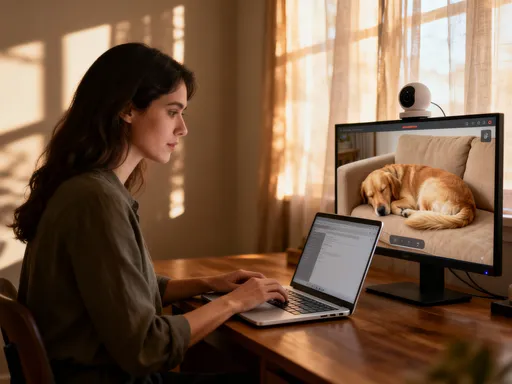
What makes these cameras different from regular home security cams? They’re built with pets in mind. They have wide-angle lenses so you can see the whole room, night vision so you can check in after dark, and two-way audio so you can talk to your dog like you’re right there. Some even come with treat dispensers you can trigger from your phone. Imagine this: you’re in the middle of a long Zoom call, and you get a motion alert. You glance at your phone and see your dog pacing by the door—maybe she needs a bathroom break. Instead of interrupting your meeting, you wait until there’s a pause, then quietly say through the camera, “It’s okay, Luna, Mommy’s here.” And just like that, she lies down. No panic, no chaos, no guilt.
The emotional relief is real. It’s not about spying on your pet—it’s about connection. It’s knowing that when she barks at the mail carrier, you can see it happen, understand why, and calm her down remotely. It’s hearing her settle after a thunderstorm because you played a lullaby from your app. These small moments add up to a bigger sense of calm—for both of you. One mom I spoke to told me she used to dread thunderstorms because her rescue dog would panic and hide under the bed. Now, she gets an alert when the wind picks up, checks the camera, and turns on a soothing playlist before the storm even hits. “It’s like I’m there,” she said, “even when I’m in the middle of a spreadsheet.”
And it’s not just dogs. Cat owners use these cameras to catch sneaky behaviors—like the one who figured out how to open the kitchen cabinet to steal treats. With motion alerts, you get a notification the second the door creaks open. You can watch the whole heist unfold in real time and laugh instead of clean up a mess later. The technology doesn’t replace attention or care. It enhances it. It gives you the gift of presence without requiring physical presence. And that’s powerful.
Real Moments: When the Camera Caught What I Missed
Let me tell you about the time my camera saved my grandmother’s quilt. It was a rainy Tuesday, and I was deep in a budget review when my phone buzzed. The app showed motion in the living room. I tapped the screen, and there was Luna, dragging the edge of the quilt off the couch—her new favorite chew toy. Without the alert, I wouldn’t have known until it was too late. But because I saw it in real time, I used the two-way audio to call her name. She looked up, dropped the fabric, and trotted over to her bed. Crisis averted. That quilt means everything to me. I don’t even want to think about what would’ve happened if I hadn’t been able to intervene.
Then there was the morning my neighbor’s dog got loose and ran into our yard. I saw it on the camera before I heard the barking. My cat, Miso, was on the back porch sunbathing—completely unaware. The other dog started charging toward the sliding door. I quickly turned on the outdoor speaker connected to the system and clapped my hands through the audio. The intruder dog startled and ran off. Miso didn’t even open her eyes. I felt like a secret superhero—protecting my pets from my desk, invisible but effective.
Another user, a teacher named Sarah, shared how her camera helped during a heatwave. She noticed her cat wasn’t moving much and was panting in front of the fan. The camera had a room temperature sensor, and the app alerted her that it was over 85 degrees. She called a neighbor to check in, and they realized the AC had stopped working. Thanks to that small alert, her cat got fresh air and water in time. “It wasn’t just about convenience,” she said. “It was about safety. I felt like I was doing my job as a pet parent, even from miles away.”
These aren’t rare, dramatic events. They’re the quiet, everyday wins that make a huge difference. The peace of knowing your pet isn’t stuck behind the couch with a toy stuck on their head. The relief of catching a leaky water bowl before it ruins the hardwood. The joy of watching your dog greet you at the door the second you say, “I’m home!” through the speaker. These moments don’t make the news, but they fill your heart. And they add up to a life that feels more in control, more connected, more balanced.
Setting Up Your System Without the Tech Headache
Now, I know what you might be thinking: “This sounds great, but I’m not tech-savvy. I can barely set up a printer. How am I supposed to install a whole monitoring system?” I get it. That was me too. But here’s the truth: most of these cameras are designed for people like us—busy, caring, not engineers. The setup is usually as simple as plugging in the device, downloading an app, and following the step-by-step guide. Many even have video tutorials built right into the app. It took me less than 20 minutes to get mine working.
The key is choosing the right camera for your lifestyle. Look for one with a strong Wi-Fi connection, clear video, and easy app navigation. Don’t get overwhelmed by features. Start with the basics: live video, two-way audio, and motion alerts. Once you’re comfortable, you can explore extras like treat dispensers or lullaby players. I added a treat feature later, and honestly? It’s more fun than useful. But my dog loves it, so it’s worth it.
Placement matters. Put the camera where you’ll get the best view of your pet’s favorite spots—near their bed, by the back door, or in the main living area. Avoid pointing it directly at a window with bright sunlight, as that can wash out the image. And test the audio. Make sure you can hear your pet clearly and that your voice comes through without echo. I placed mine on a bookshelf at eye level, angled slightly down. Perfect.
Also, think about privacy. These cameras are connected to the internet, so choose a brand with strong security—look for end-to-end encryption and regular software updates. Use a strong, unique password and enable two-factor authentication if available. Your pet’s safety includes digital safety too. And don’t forget to position it so it doesn’t capture sensitive areas of your home. You want to see your dog, not your mail or computer screen.
Finally, give yourself grace. If the first spot doesn’t work, move it. If the app freezes, restart it. This isn’t about perfection. It’s about progress. Within a day or two, you’ll forget it’s even there—until it pings with an alert and reminds you how much it helps.
How Peace of Mind Boosts Your Work Focus
Here’s something I didn’t expect: once I stopped worrying about my dog, my work improved. Not because I suddenly had more time, but because I had more mental space. Before the camera, I’d check on Luna every 10 to 15 minutes. That’s at least four disruptions per hour. Each one pulls you out of deep focus, and it takes an average of 23 minutes to get back into the zone. That’s over three hours of lost productivity every day—just from worry.
With the camera, I don’t need to get up. I can glance at my phone during a natural break—between calls, while waiting for a file to load. No disruption, no guilt. And because I can respond remotely, I often don’t need to intervene at all. That sense of control reduces anxiety, which in turn improves concentration. I’m not just physically at my desk—I’m mentally present too.
Studies show that lower stress levels lead to better decision-making, faster problem-solving, and higher overall job performance. When you’re not carrying that background hum of worry, your brain works more efficiently. I started completing tasks faster, missing fewer deadlines, and even taking on new projects. My boss noticed. “You’ve been really focused lately,” she said. I smiled. She had no idea how much of that focus came from a little camera in the living room.
And it’s not just about productivity. It’s about presence. When work ends, I can truly disconnect because I know I didn’t cut corners. I gave my job my best, and I didn’t sacrifice my pet’s well-being to do it. That balance feels good. It feels sustainable. It feels like winning.
Building a Routine That Works for You and Your Pet
Technology is a tool, not a magic fix. The real change happens when you combine it with simple, consistent habits. For example, I use the camera to learn my dog’s patterns. I noticed she gets restless about two hours after breakfast, so now I schedule a short play session around that time. It’s not just good for her—it breaks up my workday and gives me a mental reset too.
I also created a “quiet zone” in the living room—a cozy corner with her bed, toys, and a water bowl. I positioned the camera to focus on that area so I can see when she’s settled. When she’s in her zone, I know she’s calm. When she’s pacing, I know she might need a break. The camera helps me respond with intention, not panic.
Feeding and walking times have improved too. I used to guess when she needed a walk, but now I watch her behavior on the camera. If she’s sniffing by the door or scratching at the rug, I know it’s time. I’ve even adjusted her feeding schedule based on when she seems hungriest. These small tweaks, informed by real-time observation, have made her happier—and me less reactive.
The key is using the tech to support, not replace, your role as a pet parent. It’s about creating harmony, not dependency. You’re still the one who loves and cares for your pet. The camera just helps you do it more effectively, especially when you’re busy. It’s like having a second set of eyes—ones that never get tired or distracted.
More Than Convenience—It’s About Connection
At the end of the day, pet monitoring isn’t about gadgets. It’s about love. It’s about wanting the best for your pet while also living your life fully. We don’t want to choose between being good at our jobs and being good pet parents. We want to be both. And we can be—when we have the right tools.
This technology doesn’t create distance. It deepens connection. It lets you check in, soothe, protect, and celebrate—all from a distance. It turns small moments into meaningful ones. The wave when you say hello. The treat drop that makes your dog spin in circles. The calm voice that quiets a storm-induced panic. These are acts of care, made possible by a simple device.
And in a world that often asks us to do more with less, this is a rare win: something that saves time, reduces stress, and increases joy—all at once. It’s not about surveillance. It’s about staying close. It’s about peace of mind, focus at work, and a deeper bond with your pet. It’s about living a calmer, more connected life—one paw print at a time.